
Indian Rupee to Dollar Value: Today’s Rate & Historical Context
This rate shows how strong or weak our rupee is compared to the US dollar.
Right now, the value keeps changing every day because of the economy, global markets, and government policies. Think of it like the price of something in a shop – demand and supply keep shifting, so the price moves up and down.
This guide will help you understand:
Today’s rupee-to-dollar rate
Why the rate changes
How the rate has moved from 1947 till now
What this means for you – travel, buying stuff, and India’s economy
FAQs that clear up the confusion
1 USD = 89.96 INR
Why the INR to USD Rate Keeps Changing: Key Factors Explained
Let’s keep it simple. The rupee moves because of economy ka mood — India’s and the world’s. Here’s what actually pushes it:
1. Economic Factors Inside India
High inflation = weak rupee
Good GDP growth = stronger rupee
High foreign investment = more demand for rupee
Big trade deficit = pressure on rupee
2. Global Events & USD Strength
When the US economy is strong, USD becomes stronger
Oil prices going up = India paying more = rupee weakens
Wars, global tension, financial crises – all affect currency
3. RBI’s Actions
RBI sometimes buys or sells dollars to control sudden changes.
Think of RBI as a referee – it can’t play the match, but it can keep the game under control.
Historical INR to USD Exchange Rate: A Timeline (1947-Present)
Let’s look at how the rupee travelled from Independence till today.
You’ll be surprised – the journey is wild.
Before 1947 – Silver Standard
India used silver, not gold, so the rupee’s value shifted based on silver prices.
1947-1973 – Fixed Exchange Rate
In 1947, 1 USD ≈ ₹3 to ₹4 (yeah, really!)
India kept the currency fixed, not floating like today
Big devaluations happened in 1966
1973-1991 – Peg to Basket of Currencies
Rupee was controlled by govt and RBI
Still not fully market-driven
Value slowly slipped as the economy struggled
1991 Onward – Free/Floating Rate
1991 crisis → rupee was devalued
India allowed the market to decide the value
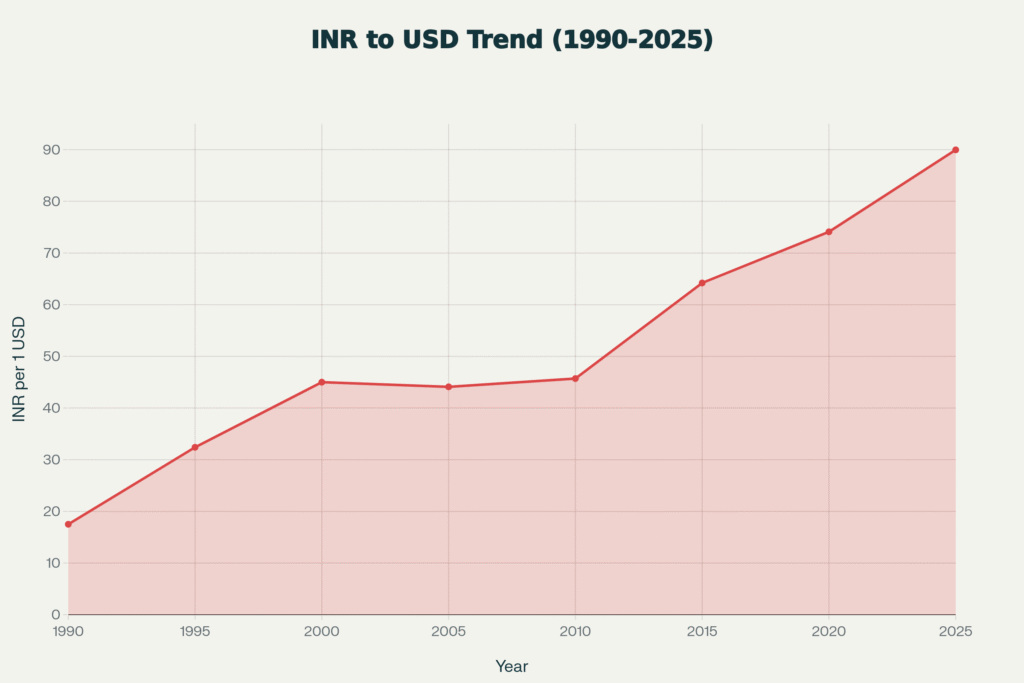
After 2000s, USD generally stayed stronger
Recent years: rupee hit multiple record lows
Tables or graphs can be added here to show year-by-year changes.
Graph: INR to USD Long-Term Trend
Key Moments When the Rupee Crashed or Recovered
Some major events that changed the rupee’s value:
1966 devaluation : huge drop
1991 crisis : India almost ran out of dollars
2008 financial crisis : global shock
2013 taper tantrum : foreign investors pulled money
2020 COVID crash : uncertainty, rupee weakened
2022-2024 : strong USD + high oil prices = rupee pressure
How to Convert INR to USD (Simple Guide)
If you’re travelling abroad or doing online payments, here’s the easy method:
Steps:
Check the live INR-USD rate (Google or RBI link).
Multiply your rupees by the current rate.
Compare rates from banks, forex agents, and apps – charges can differ.
Avoid last-minute airport exchanges – they loot you with fees.
Watch out for:
Hidden fees
Commission
Extra GST
Fake “zero commission” claims
Why INR-USD Movements Matter for You
A weaker rupee affects everyone, not just the government.
Travel becomes more expensive (USD rate high = costly trips)
Imported goods get expensive (phones, laptops, oil)
NRIs send more value in remittances
Businesses that import raw materials suffer
Exports become more competitive
Market Forecast: What Experts Expect for INR vs USD
Nobody can predict currency perfectly – not even experts.
But analysts say future movements depend on:
India’s inflation
RBI’s interest rates
Oil price trends
Global market stability
US Federal Reserve policies
Some predict slow depreciation; others expect stability if India’s growth stays strong.