
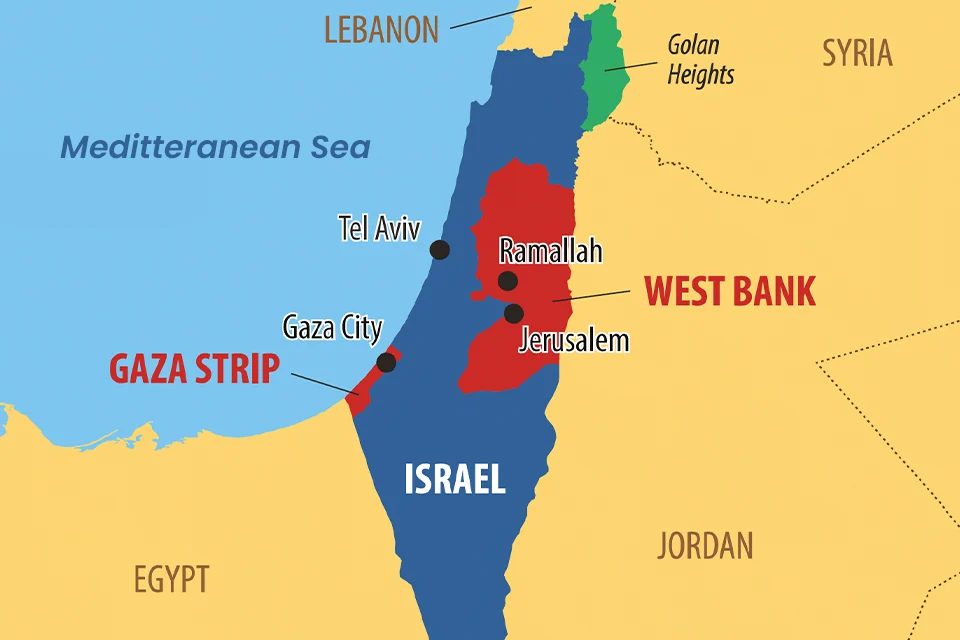
Middle East Conflict: Israel and Palestine is one of the longest, messiest, and emotionally charged fights in modern history. It’s about land, identity, religion, power, and who gets to live where.
Both sides believe they have a right to the same land, and both have deep historical reasons. But decades of wars, violence, politics, and broken deals have made things way more complicated than a simple “who owns what.”
Origins of the Israel and Palestine Conflict
Let’s rewind. This fight didn’t start last week. It didn’t even start 50 years ago.
It goes all the way back to the early 1900s, when the region was under foreign rule.
The Ottoman Era and British Mandate
Before Israel existed, the land was part of the Ottoman Empire for hundreds of years. People living there included mostly Arab Muslims and Christians, and a smaller number of Jews.
Then after World War I, the British took control. This is where trouble starts.
Rise of Zionism and Early Jewish-Arab Tensions
Jewish communities in Europe started pushing for a homeland because of rising antisemitism. This movement is called Zionism. Many Jews moved to Palestine, which caused friction with Arabs who were living there.
Balfour Declaration
In 1917, Britain basically said:
“Yeah, we support creating a homeland for Jews in Palestine.”
This made Arab communities feel betrayed and ignored. The tension escalated.
Partition Plan, Creation of Israel & First Arab-Israeli War (1947-1949)
In 1947, the United Nations said, “Cool, let’s split the land into two countries – one Jewish, one Arab.”
Jews agreed. Arabs didn’t.
In 1948, Israel declared itself a country. Arab nations attacked.
Israel won the war and took more land than the UN originally planned to give.
This created massive anger in the Arab world and changed everything.
The Nakba: Palestinian Exodus and Refugee Crisis
“Nakba” means catastrophe in Arabic.
Around 700,000 Palestinians were forced to flee or were expelled from their homes during the 1948 war.
Many ended up in refugee camps in countries like Lebanon, Jordan, and Syria.
These families are still fighting for their right to return.
Major Wars and Shifts (1948-1967)
Between 1948 and 1967, several wars happened. The most important one: The Six-Day War in 1967.
Israel won again and captured:
West Bank
Gaza Strip
East Jerusalem
Golan Heights
Sinai Peninsula
This is where the “occupied territories” issue comes from.
And honestly? It’s one of the biggest sources of anger and fights today.
Territories in Dispute: West Bank, Gaza Strip, Jerusalem
Let’s break this down simply:
West Bank
Israel controls it. Palestinians live there.
But Israel keeps building settlements – which most countries say are illegal.
This creates daily tension.
Gaza Strip
A tiny, overcrowded area ruled by Hamas since 2007.
Israel and Egypt control its borders.
Gaza faces major restrictions, very high poverty, and frequent conflict.
Jerusalem
Both Israel and Palestinians claim it as their capital.
It’s extremely important for Jews, Muslims, and Christians.
This city is basically the heart of the fight.
Palestinian Refugees and Right of Return
Millions of Palestinians today are descendants of families displaced in 1948 and 1967.
They want the right to go back home.
Israel fears this would change the country’s population balance.
Result: Massive deadlock.
Peace Attempts & Diplomatic Efforts
There have been a ton of peace talks:
Camp David
Oslo Accords
Roadmap for Peace
Some progress happened, but nothing stuck.
Why?
Because both sides have core issues they don’t want to compromise on – land, security, refugees, Jerusalem.
Rise of Militancy and Uprisings (Intifadas)
Palestinians rose up twice (called Intifadas).
These were huge uprisings against Israeli control.
On the other side, groups like Hamas carried out attacks against Israel.
Israel responded with force.
It created a cycle: attack → retaliation → repeat.
Recent Conflicts & Gaza Wars
(2000s to Today)
There have been repeated wars between Israel and Gaza:
2008
2012
2014
2021
2023 (the most destructive one so far)
The 2023 conflict started after a major Hamas attack on Israel.
Israel launched a massive military response in Gaza.
Thousands died. Entire areas were destroyed.
It became one of the worst humanitarian crises in recent history.
Current Status (Who Controls What?)
Israel controls Israel, West Bank, and East Jerusalem.
Palestinians control some parts of West Bank (politically), but Israel controls borders and movement.
Gaza is controlled by Hamas but blockaded by Israel and Egypt.
Basically, the region is divided, tense, and unstable.
International Involvement
Everyone has an opinion on this conflict:
USA mostly supports Israel.
Arab countries support Palestinians (openly or quietly).
Iran supports Hamas and other armed groups.
UN repeatedly calls for peace and humanitarian access.
This conflict isn’t just Israel-Palestine.
It pulls the whole Middle East into its orbit.
Humanitarian Impact
The people pay the price. Always.
Civilians – not presidents, not military leaders – suffer the most.
Displacement
Homes destroyed
Lack of clean water and electricity
Thousands killed
Psychological trauma
Generations growing up in fear
It’s brutal, and no amount of politics can hide that.
Future Possibilities: Any Way Out?
There are three main ideas talked about:
Two-state solution : Israel and Palestine as separate countries
One-state solution : everyone lives together under one government
Confederation idea : shared land, shared systems
But truthfully?
Right now, nothing looks close.
Too many political divisions, too much distrust, and too much violence.
Why the Conflict Still Continues
Simple answer:
- Both sides want the same land.
- Both sides feel wronged.
- Both sides don’t trust each other.
- And global politics keeps making it worse.